A legume, or legume, is the fruit of a plant in the pea family (Fabaceae), and they are used both as animal feed and as human food. Peas, beans and lentils are included in what we call legumes because the seeds, which we mainly eat, are in a pod. Peanuts, clover and alfalfa are other examples of legumes. Legumes are special because most of them live in symbiosis with nitrogen-fixing bacteria. The bacteria are found in structures on the root nodules deep in the soil. Because of the nitrogen-fixing bacteria that fertilize the soil, these crops play an important role in crop rotation on farms.
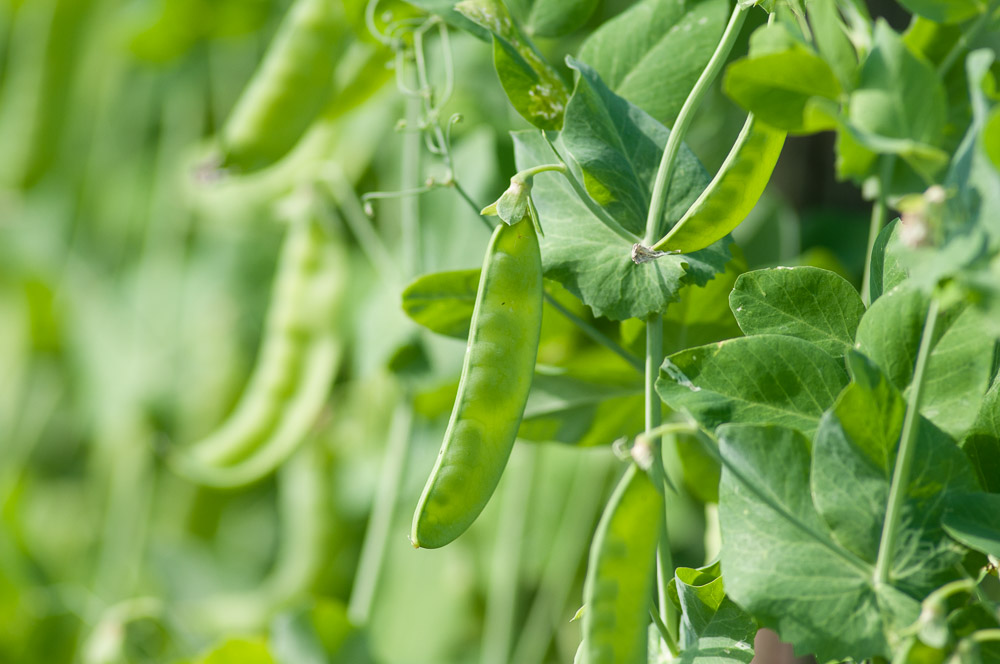
Sugar beet Early green sable. Photo: solhatt.no.
Sugar peas
Early green sable
Tidlig grønn sabel is a Norwegian sweet pea variety. Its origin is not completely known, but one theory is that the variety originates from a selection made in the variety Tidlig sabel. Tidlig sabel was the result of breeding work done by Professor Bremer at the Norwegian University of Agriculture (now NMBU) in Ås in 1928. Professor Bremer crossed a selected line of the variety Engelsk sabel with the piller variety Saxa. The result of the cross was a variety that was earlier than the variety Engelsk sabel. Tidlig grønn sabel is a tall-growing variety that produces lots of tasty pods.
In 2014, the variety was approved as a traditional variety and PLANTEARVEN® variety.
English Sabre
This variety came to Norway in the late 1800s. Early in the 1900s, several Norwegian seed companies had their own strain of English Sable. The variety is almost a week later than Early Green Sable, but has a greater yield potential. The variety produces large, wide and juicy pods. The taste is best when the peas have not started to develop. Height 1.5-1.8m.
In 2016, English Sable was approved as a conservation variety.
Pear-sugared Bremer
Sweet peas are a type of garden pea that is the result of a cross between a sweet pea and a daisy. Unlike regular daisies, sweet peas have no membrane in their pods. In the 1920s, AH Bremer Oppegård crossed a strain of the English sable sweet pea with the Witham Wonder daisy. The result was Sweet peas Bremer. The variety is low (approx. 50-70 cm) and can do without or with little support. The variety has wrinkled, green daisy seeds and long, pointed pods that always sit two by two on each stem. This makes it easy to pick. The pods stay juicy and green for a long time, and can be used long after the seeds have developed. The pods develop 8–10 large, sweet seeds, and it can give a large yield. The variety can also be used excellently as a daisy.
Margsukkerert Bremer was approved as a conservation variety on the Norwegian variety list in 2018.