Grain and bread have a special place in our culture and history. In the Middle East, where grain plants come from, people have been harvesting grain for food for 20,000 years. Farming with the cultivation and storage of grain led to people becoming farmers and settled. Here in the north, grain has been grown for 4,000 years. In Norway, most barley is grown today, followed by oats, wheat and a little rye. Since the first grain plants were sown and cultivated over 10,000 years ago, farmers have harvested seeds from the best plants in the field every year, and in this way the grain varieties have gradually become better adapted to the climate and growing conditions, and yields have increased.
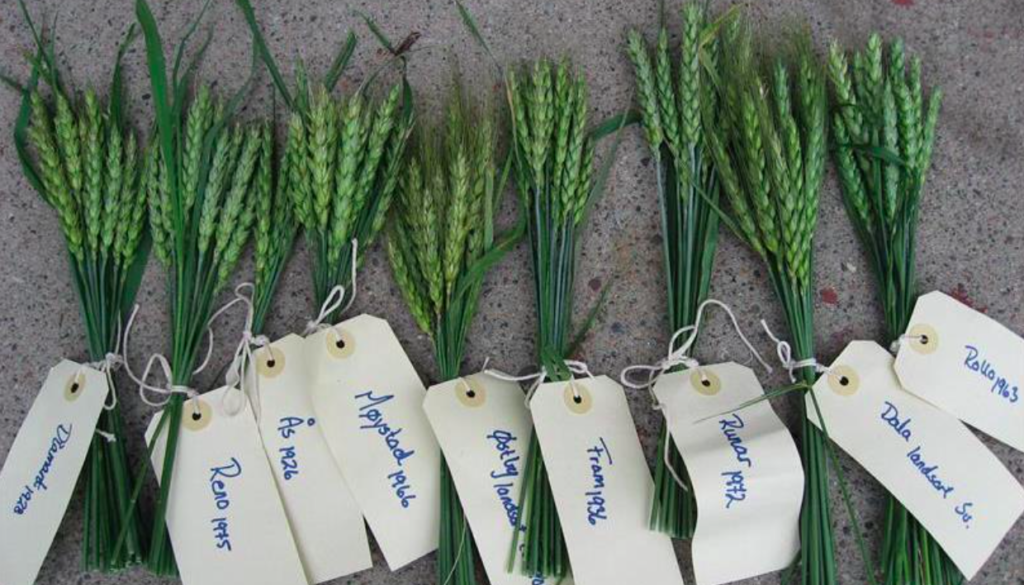
Grain varieties Photo: Norwegian Agricultural Advisory Service Østafjells.
Discontinued varieties are again available
In Norway alone, hundreds of so-called landraces have emerged, where farms and hamlets often had their own locally adapted types of grain. Since the beginning of the last century, modern plant breeding and new varieties have gradually taken over from the old landraces. The lifespan of new varieties has also become increasingly shorter, and therefore both landraces and newer varieties from the 20th century have disappeared. It gradually became clear that the varietal diversity that was disappearing was valuable genetic resources for future agriculture, and in 1979 the Nordic Gene Bank (now NordGen) was established with the aim of preserving seeds and plants with genetic material from cultivated plants.
The gene bank at NordGen currently contains over 1,600 varieties and landraces of cereals. Small portions of seeds from these are available to plant breeders, researchers and other users. For farmers who want to grow, it is possible to obtain larger portions from the commercial gene bank. If you have viable seeds of an old cereal variety, it is welcome in the gene bank.
Characteristics of the varieties
Modern varieties usually give the highest yield and best grain quality in modern agriculture with modern cultivation techniques. That is why the old varieties are replaced. However, older varieties may have characteristics that are suitable for particular production methods and
for special products:
- In more extensive farming, e.g. in organic farming without artificial fertilizers and pesticides, some older varieties have been shown to give consistent and year-round yields.
- Landraces are less uniform than modern varieties and have greater genetic variation. This enables further development of the variety, e.g. adaptation to climate change and new growing conditions.
- Some old varieties have taste and baking properties that are suitable for good and tasty baked goods.
- Some older varieties have a high content of protein, vitamin E and trace elements.
- Some older varieties have a protein composition that people with food intolerance can tolerate.
- There is a market for flour and baked goods from varieties with rich traditions and cultural history.
- Some varieties may have very special growing characteristics, such as ryegrass that tolerates alkaline soil and that bushes so well that it can produce more than 1,000 new grains from one seed.
Sources
- Norwegian Agricultural Advisory Service : The Grain Gene Bank