Plant breeding means developing plant varieties or plant forms that are better suited to the cultivation purpose than the varieties or forms that are already in use. It is the process where we select traits to breed further, and crossbreed varieties and species to produce desired traits. This can be done in several different ways.
Selection and crossing
The simplest form of plant breeding involves selecting the best plants (selection) within a population. In such breeding, selection is only made among the characteristics that already exist in a population. No new combinations are created.
Crossbreeding creates new genetic variation. Targeted combination breeding, where one variety/line (line A) is crossed with another (line B), was described by Gregor Mendel and became common in Norway in the early 1900s. However, it had been practiced in both China and the Netherlands long before that time. The method still dominates plant breeding, although new techniques are constantly being developed.
Open-pollinated varieties
Such varieties are freely pollinated within a population and contain a variety of plants. The varieties produce seeds with the characteristics of the parent plants. Seeds can be harvested and used for further cultivation. There is little change from one generation to the next; we say that the variety is varietal.
Varietal food plants have adapted to their habitats through decades of natural selection and deliberate strategies by growers. Therefore, they provide a robustness that will be appreciated in an era of more changeable and unpredictable climate. Such plants will also have been largely crossbred in an era when plants received less help from pesticides and mechanical tillage, and may therefore have better nutrient uptake and a more robust root system.
Some plants are self-pollinating. Then there is little risk that different varieties will cross themselves if they are close to each other. Other plants cross easily. To be sure that the seeds are of the right variety, one must then ensure that the variety is isolated from others with which it can cross, either in time, space, or physically. For example, the isolation distance can be about 1000 meters for carrots, which cross easily and are insect-pollinated, but only 3 meters for wheat, which is mostly self-pollinating.
F1 hybrids
F1 hybrids produce plants that are identical, which can be a great advantage during harvesting, sorting and selling. Such varieties dominate the vegetable market and are also common in rye, rapeseed, maize and other cross-pollinated agricultural crops. The method can also be applied to self-pollinating species such as tomatoes, peppers and chillies.
Hybrid varieties are developed by crossing two selected parental lines, which have in turn been inbred for many generations. The parental lines are very different lines from each other. The hybrid has a positive cross-breeding effect (heterosis) and in terms of appearance, the F1 hybrids are very uniform and very vigorous. This is due, among other things, to a naturally inherited mechanism in the plants to give healthy genes a competitive advantage over the inbred plants. In order to produce your own parental lines more quickly, a laboratory technique called double haploid or microspore culture can be used. F1 hybrids cannot be used for further seed propagation, as the result is very heterogeneous plants. To breed seeds, the parental lines of the hybrids are needed, but these are owned and controlled by the breeding companies.
Ovarian and embryo culture
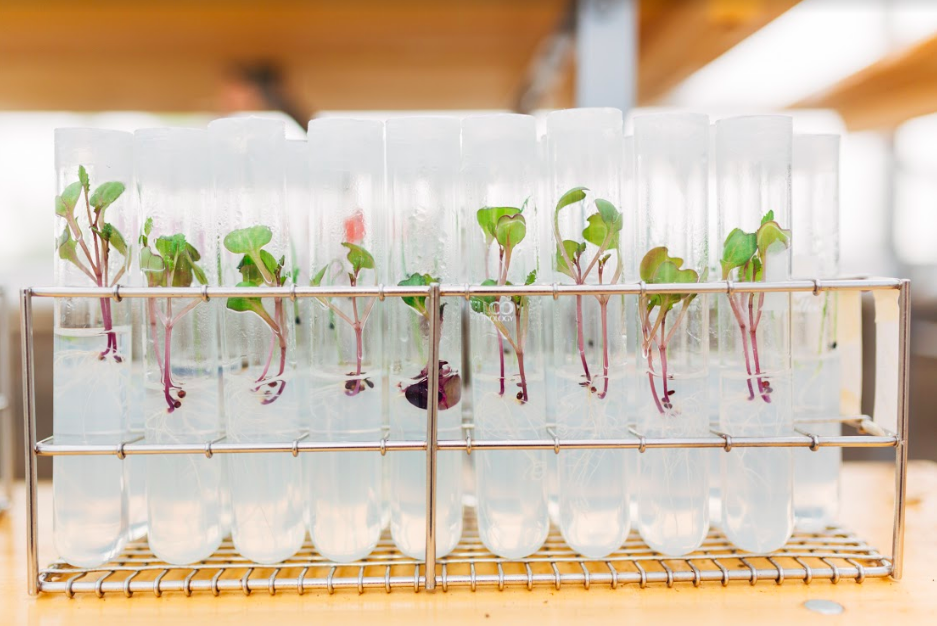
There are also techniques that can make it possible to cross species that are not naturally easy to cross. This is a laboratory technique where seed plants are removed from the mother plant at an early stage and transferred to a growing medium (agar). The technique is used in connection with "rescuing" plants that would otherwise not survive after crosses between cultivated crops and closely related wild species (wild relatives). The use of wild relatives in breeding is resource-intensive, but can be useful for introducing new resistance genes.
History
Historically, plant breeding has gone through various phases – from the time when farmers themselves took care of plant breeding – to public plant breeding at regional research stations and to present-day plant breeding, which is run by national and international companies. In Norway, the number of species being bred has decreased, for example, the breeding of cabbage, onion and several grass species has been discontinued. Breeding is still found in barley, spring wheat, oats, potatoes, strawberries, raspberries, apples, plums, timothy, red clover and some other grass and legume crops. Vegetable breeding does not exist in the Nordic countries. The breeding of peas was the last to disappear. This happened when Findus moved the research department from Skåne in 2017.
Sources
- Agropub: Old varieties, living cultural heritage and useful genes
- Agropub: A small miracle about plant breeding and technology
- Textbook for upper secondary school: Plant breeding and propagation
- Clean Food: From Seed to Food
- Great Norwegian Encyclopedia: Gregor Mendel
- Large Norwegian Encyclopedia: Plant breeding
- Great Norwegian encyclopedia: Seed breeding
