There are between 6 and 7,000 plant species in the world that are used for food. Yet 66% of all crops come from just nine species . The nine are sugarcane, maize, rice, wheat, potato, soybean, sugar beet, cassava and oil palm. The diversity of varieties in agriculture has declined rapidly worldwide over the past hundred years. The genetic diversity of food plants is crucial for agriculture. What we manage to preserve for the future determines what opportunities future generations will have to grow food under changing climate and environmental conditions.
Photo: Kore Foundation.
Agricultural biodiversity – the foundation for food security
Agricultural diversity is one of the most valuable resources that farmers manage. Here we will mainly focus on plants, but both food plants and livestock come in many varieties . The variations ensure adaptation to different climates and farming systems, give us a variety of tastes and foods, and help us meet market demand . Biodiversity is the basis for food security in the future. Different plant varieties have different characteristics, and when you preserve a diversity of varieties, you are more likely to have varieties that can withstand changing growing conditions. Some plants may have special resistance to pests and diseases, while others can withstand poor soil, drought or flooding.
Biodiversity is genetic diversity
The genes and gene combinations that make up this diversity are called genetic resources. These resources sustain current food production and support the livelihoods of farmers around the world. But we also need these resources to meet the future. Farmers need a constant supply of new plant varieties to adapt as agriculture and climate change and to meet new market needs and wants. This requires crop and seed selection and can only work as long as the genetic seed base is maintained and available.
Sustainable agriculture and the conservation of agricultural biodiversity are closely linked factors. The conservation, use and further development of agricultural biodiversity is a prerequisite for running local and needs-adapted agriculture.
Species diversity
Many food plants belong to the same species, which are then bred to become many different varieties. For example, tomatoes are the species tomato, but there are infinitely many varieties , which give tomato plants with different growth forms and tomatoes in all possible sizes, colors and shapes. Species diversity therefore concerns larger main groups. In Norway, many different species of food plants are grown today, but not all are grown in large volumes. What we grow most of is grain (different types, mostly barley), potatoes, carrots, lettuce, onions and apples.
Statistics Norway has statistics on the production of potatoes , grains and vegetables .
Experiments are being conducted with new crops that can work in our climate, new species that we have not grown here before, including quinoa and sweet potatoes.
Variety diversity
A variety is, as mentioned, a refined variant of a species. For example, “Mikeli” is a black cabbage, and cabbage is a cultivar of the wild species Brassica oleracea. Other cultivars of the same species include broccoli, cauliflower, kohlrabi and Brussels sprouts.
Plant diversity in agriculture is a vast reservoir of exciting flavors, aromas, colors, nutrients, stories and possibilities. It is the genetic basis for all food production and crucial to our prospects for securing this production against plant diseases, pests and the effects of climate change. Plant diversity is therefore the single most important environmental factor for agriculture today, precisely because it determines whether it will be possible to adapt food production to changing environmental conditions. In this way, a large variety of plants can be considered a life insurance for future generations, while already giving us opportunities today to meet changing nutritional needs and needs in agricultural production. But plant diversity is disappearing at a rapid pace, and legislation and regulations are making access to these resources – and their use – increasingly difficult.
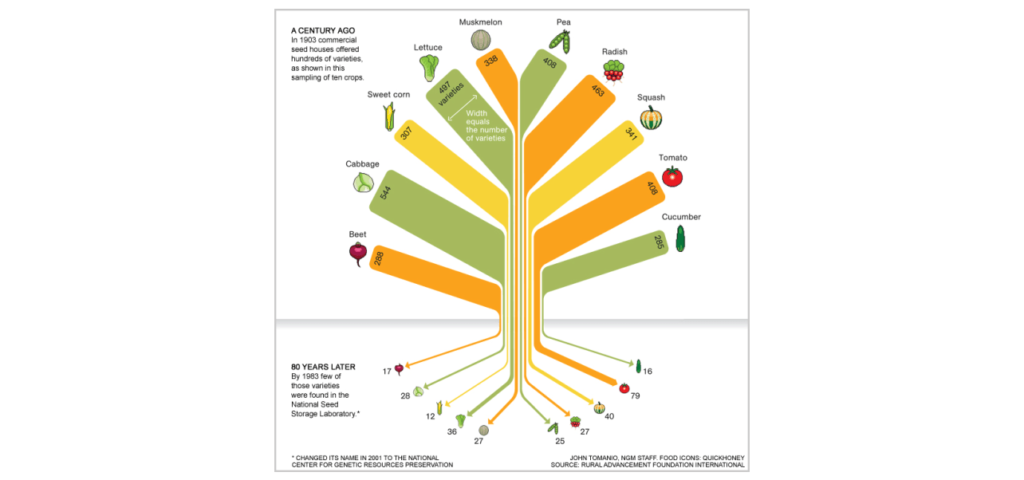
Breeding of plant varieties
While modern breeding aims for a new plant variety to produce homogeneous plants in a field, many old varieties are more heterogeneous. For some forms of production, heterogeneity is also an advantage, for example, in that some plants in a more heterogeneous population do well in a dry summer or resist fungal attack in an unsprayed field, or in that the plants mature at different rates, so that one can harvest cabbage for sale from a field over a long period of time, and not have to harvest all of them at once.
For commercial cultivation in large quantities, approved varieties must be used. In particular, the requirement that the variety be uniform/distinguishable has stopped many old varieties.
Sources:
- Norwegian Institute for Nature Research (NINA): What is the importance of insects in our nature?
- Statistics Norway (SSB) www.ssb.no
- Agropub.no : Biological diversity
- Agropub.no : Spiders and other beneficial animals in grain and meadows
- Agropub.no : Tough for diversity farmers
- Organic Norway: Biodiversity in the service of agriculture
- Nationen: Applied gene banks important for plant diversity
- Illustration : https://www.fastcompany.com/1669753/infographic-in-80-years-we-lost-93-of-variety-in-our-food-seeds