The plants where we mainly eat the part with seeds are called fruit crops. Botanically, the fruit is the part of the plant where the seeds are located, regardless of whether the plant tastes sweet or not. It can be, for example, a tomato, pepper, squash, pumpkin or cucumber, but of course also what we usually think of as fruit, such as apple, plum and orange. Most fruits depend on the flowers being pollinated by insects in order to develop.
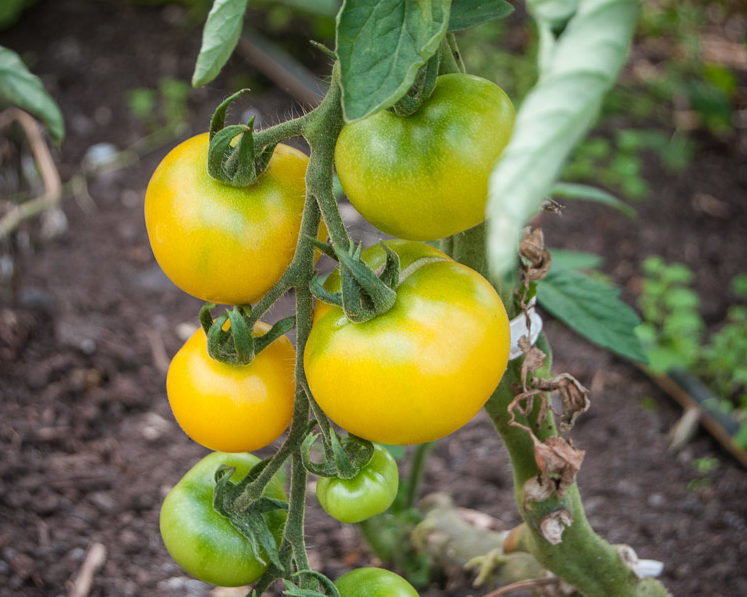
The tomato Ansofs yellow. Photo: solhatt.no.
Tomato
Ansof's yellow
Ansofs yellow is a variety that has been grown in Norway for about 100 years. The plants have a strong, compact growth, about 100-120 cm tall. Ansofs yellow is a relatively late variety and is therefore not suitable for growing outdoors. In the immature stage, the fruit walls are medium thick, but they become soft when the tomatoes are fully ripe. The plant produces large clusters of small, warm yellow, round tomatoes - most of them around 30 grams. The taste is sweet and good.
Ansofs Gule is listed as a traditional variety on the Norwegian variety list.
PICTURE
Norderås Bush
The tomato variety 'Norderås Busk' is the result of breeding work carried out at the Department of Vegetable Growing at the Norwegian University of Agricultural Sciences (now NMBU) in the 1950s. The variety can also be planted outdoors. The fruit walls are thick, but the fruits become soft when the tomatoes are fully ripe. The variety is relatively early, robust, has a good taste and produces a high yield. It is quite resistant to disease, and can withstand some rain and cool weather. On bush tomatoes, you do not need to remove side shoots, but it is an advantage to limit the number of stems to 3 or 4. This gives a more controlled growth with less foliage and larger fruits. Too much foliage increases the risk of fungal diseases.
Norderås Busk is listed as a traditional variety on the Norwegian variety list.
PICTURE
Sources:
- Sunhatt : https://solhatt.no/
- Tomato talk : http://tomatprat.blogspot.com/2016/08/ansofs-gule.html