Brassicas are plants in the cruciferous family, specifically in the genus Brassica . They have the typical cabbage flavor, and come in many different forms. All cabbage plants are different varieties where different parts of the plant have been bred to be extra-large. Brussels sprouts have large side shoots, kohlrabi has a swollen stem, cauliflower and broccoli have extra-large flower heads. But they all come from the same species originally. Cabbages are biennial plants, meaning that the plant flowers and sets seeds the second year. The exceptions are cauliflower and broccoli.

Head cabbage Mikeli. Photo: solhatt.no.
Cabbage
Cabbage Kvislar
Norwegian variety that was developed in the 70s because there was a need for a good storage variety in Trøndelag. The starting point was a selection within five different strains of Langendijker cabbage from the Netherlands. Kvislar is a tall variety with high round, firm and heavy heads with good color. Good storage variety and very good taste.
Head cabbage Mikeli
Old Norwegian variety that was bred almost 90 years ago by Olaus Lima in Rogaland. Olaus Lima was one of the most important people in Norwegian cabbage breeding in the early 1900s. The starting material was a cross between three varieties, Stavanger Torg, Jåtun Amager and a blue-topped Amager. Mikeli is a fall variety with round, even and firm heads with 120 growing days. Short inner stem with good filling between the leaf attachments. Mikeli has a long shelf life in the field. Can be stored until January.
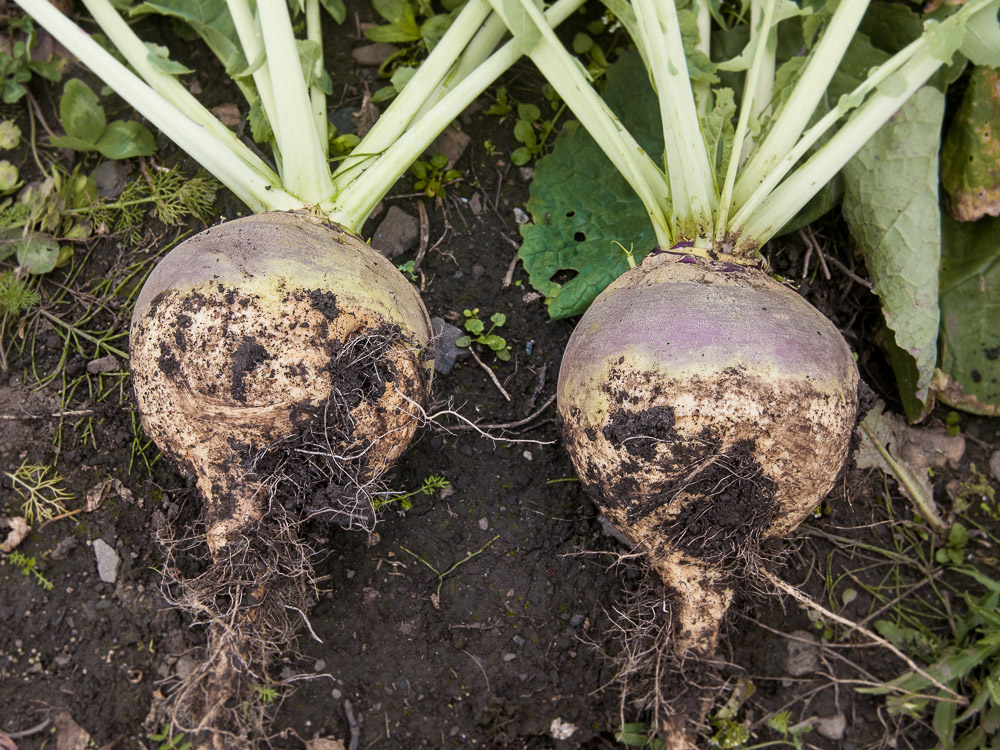
Cabbage Trønder Shelf. Photo: solhatt.no.
Turnip
There are currently two main groups of varieties in turnips, those belonging to the Bangholm group, which have a reddish-violet color on the above-ground part of the root, and the Wilhelmsburger group, which has a green scutellum. In addition, Bangholm has a somewhat yellower flesh color and a slightly higher dry matter content than the Wilhelmsburger group. All edible turnip varieties in this country belong to the Bangholm group.
Turnip Vige
Vige is a Norwegian variety that is very suitable as a food turnip. The roots are round, and have a blue-violet rind and yellow flesh. Short root neck. Strong against cane rot, some resistance to cabbage fly, but weak against powdery mildew. Good storage ability. The variety is owned by Rå high school in Kvæfjord in Troms and propagated by NIBIO Landvik in Grimstad.
Turnip Trøndersk Shelf
The variety Trøndersk Hylla originates from a trial cultivation of several strains of Trøndersk turnip from 1905-1907 carried out by manager Lysbakken at Hylla Horticultural School. Mass selection was then used where the goal was to obtain a slightly flat-round shaped, medium-sized root without a hint of a neck, with tender, yellow and tasty flesh. Blue-violet upper side, yellow underside, medium leaf growth and good storage ability. Trøndersk Hylla is listed as a variety worthy of conservation in the Norwegian variety list. Read more about this variety in NIBIO's article Renaissance for the Trøndersk Hylla turnip .
Sources
- solhatt.no : https://solhatt.no/
- Even Bratberg : https://docplayer.me/17354222-Even-bratberg-beskrivning-av-gamle-kal-og-kalrotsorter.html
- NIBIO Landvik : https://www.nibio.no/tema/landskap/froforretningen-nibio-landvik