Welcome to the table! Around this dinner table you will learn more about how you can make sustainable food choices. Imagine that you are sitting around a dinner table and can choose between an organic tomato from Viken or an imported tomato from a sunny country, and at the same time get the answer to which tomato is the most sustainable choice. You will have the opportunity to do this at KlimaMatBordet.
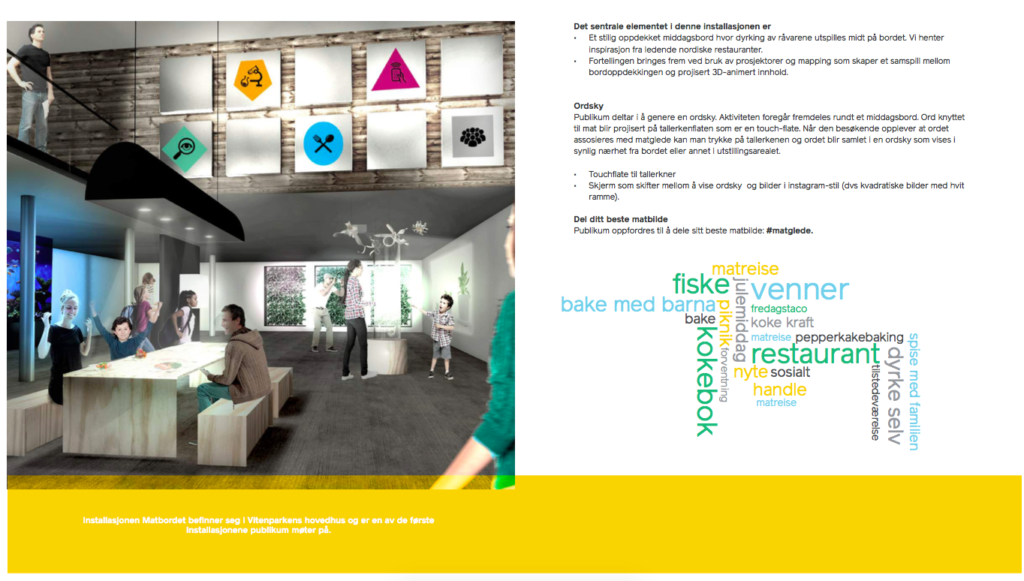
The Climate Food Table is an interactive installation that explores the connection between food, meals and climate. Welcome to the table!
The KlimaMatBordet is an interactive installation where the audience sits around a dinner table. This is a familiar setting for most of us, which reinforces the experience that we are now setting ourselves to relate to food. In the middle of the table, various edible varieties are grown that you can choose as an ingredient for your dinner. We have set the table for a meal, and on the plates a variety of dishes are prepared by a playful and entertaining little, animated chef. This experience is created using projection mapping and 3D animated content. A sound shower creates a separate soundscape for those sitting at the table and contains sounds we associate with meals, cooking and the joy of eating. An odor shower contributes to a holistic sensory impression.
Often people think that the answers are obvious. Short-distance, organic must be the most sustainable? This installation shows that the answer to the question of what is most climate-friendly, and therefore sustainable, rarely has a simple answer. Today it may be more sustainable to import tomatoes from sunny countries than to grow them in energy-intensive greenhouses in Norway, but perhaps the answer will be different in the future if the greenhouses are powered by energy from solar cells, and receive CO2 from nearby industry as nutrition for the plants?
Using a combination of graphics, projection and pressure-sensitive surfaces, this installation will explore dilemmas related to choices made in the value chain that affect climate change. It helps the audience understand the consequences of choices made by the consumer, merchant, industrial leader, distributor or farmer. Through the installation, the audience gets a sense of how things are connected in a complex system and how climate research is an important part of the picture. Looking at one factor in isolation, there may be an answer, for example, that there are high emissions related to meat production. If you look at it in connection with other factors, such as “CO2-negative” algae production that can be used for livestock feed, the answer may be that algae production + livestock farming = CO2-neutral food production.
What should we do to implement the green shift and solve the climate crisis? Should we stop eating meat or focus on algae production? The Norwegian value chain related to food is affected by global factors. We import large quantities of vegetables, fruit, berries and processed food, as well as input factors at various levels in the value chain. The installation includes real-time data, for example, global commodity prices, exchange rates, CO2 emissions and other climate and environmental data so that we can get a bigger picture of which factors affect the value chain. For the audience, this reinforces the experience that the installation is largely connected to reality. In reality, it takes a long time before you see the consequences of the choices you make, and as a consumer you never get a direct relationship to the consequences of your choices as a customer in the store, and choices that are made throughout the value chain. This installation brings the consequences of choices down to a visual and understandable level. With the help of technology, you can make connections visible in an instant that would otherwise take months and years to see the results. The installation must strike a good balance between the big picture and the choices the audience can identify with. What is the difference in environmental footprint if I buy an avocado from Peru or a squash from a cooperative farm for my Friday tacos? In the store, it is almost impossible to educate yourself about the consequences of such a choice and make informed choices about sustainability.
Background to the project
The background for the project is the three partners' joint commitment to research communication: Østfold Research, the Norwegian Institute for Bioeconomy (hereinafter NIBIO) and Vitenparken Campus Ås are three serious players within different parts of the research and communication axis. All three have a social mission that means that sustainable solutions for the future should not only be researched, but should also be communicated to the general public, preferably with targeted and adapted communication to different target groups in society. When Østfold Research, NIBIO and Vitenparken are now working together on a project, it is with our common professional area of interest that lies at the intersection of food and agricultural and climate research. Another important background for the project is that all three organizations recognize and work to overcome the public's psychological barriers to necessary climate action.
If you would like to know more about the project, please contact elise@vitenparken.no