Arouse the curiosity of the students and find the answer through various experiments. We recommend that you set aside 3-4 hours during the week. It is advisable to do the experiments while it is still cold outside (below 10 degrees).
Stage: 1st – 2nd stage
Difficulty: Easy
Time required: 3-4 hours over the course of 1 week. Preferably while it is still cool outside (not above 10 degrees).
Competency goals:
- Wonder, explore and ask questions, and connect this to your own and others' experiences.
- Present your findings and describe how you arrived at them.
Learning objectives:
- Be able to make hypotheses about what cress needs to germinate and grow in collaboration with others.
- Be able to test the hypothesis through observation.
- Know what a plant needs to germinate and grow.
Concepts: Seed, plant, sprout, grow, lack, hypothesis, temperature.
Assessment: Be able to draw the results of the growing experiment, be able to discuss the observations and conclusions, and be able to create a recipe for how to grow cress in the best possible way.
Equipment: Cress seeds, milk cartons, cotton or soil, plastic bag, refrigerator, cupboard and window post.
Activity
- Begin by presenting the cress seeds and gathering prior knowledge about what seeds need to germinate and what plants need to grow.
- Hopefully they will find water, light, heat, air and something to grow in.
- Discuss with students how to test this out. You can sow seeds and:
- Put it on the windowsill and water it.
- Put it on the windowsill and don't water it.
- Put it in the window sill and let it stand in water
- Water and put it in a closet without light
- Water and put it out in the cold
- Place seeds on a bowl without cotton and water them.
Divide the class into groups and let them follow their own experiment. After 2-3 days, they observe what has happened and draw it.
After 4 – 5 days, they repeat and examine the differences.
Conduct a discussion with the teacher in each experimental group about what the seeds have received, what they have been missing and what has happened.
Finally, it is possible to arrange for the students to make a presentation to the whole class or in groups where each experiment is represented by a student when they present. Finally, a summary in plenary.
Tips and traps
If students do not come up with all the factors, the teacher can create their own hypothesis. For example: “I think plants need air to grow.”
P4C
Who is going out? (See picture below.)
Fun facts
Some seeds and plants thrive in extreme conditions, such as cacti (very dry) or water lilies (very wet).
There is, among other things, a plant called corpse flower, which emits a smell of rotting flesh and fresh feces to attract flies. Tempting! The flies pollinate the flower, which grows in Sumatra. So we don't find corpse flowers in Norway, unfortunately. Or fortunately?
Did you know that there are carnivorous plants that grow wild in Norway? They eat small insects to get some extra nutrition, since they grow in nutrient-poor places. Soldogg looks a bit like a big mouth and slowly closes around its prey when it lands on the plant. Tettegras and bladderwort are two other carnivores.
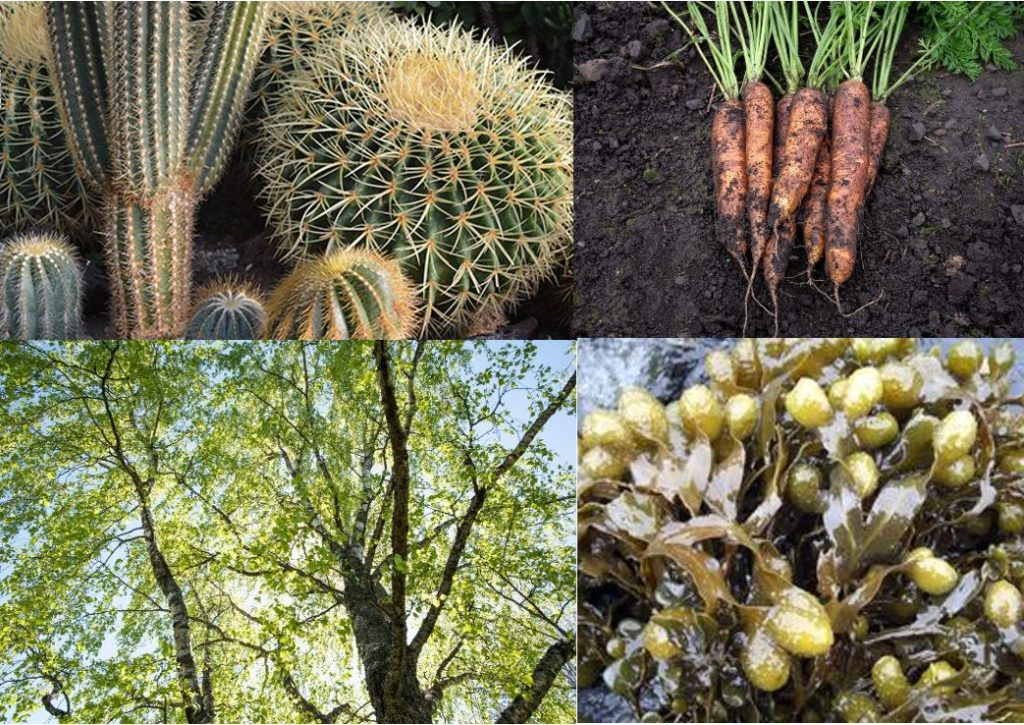
Suggested image composition for a who should be out task. There is no right answer here, the most important thing is that the students justify their choice. They are all plants, but they all stand out in their own way. Here it is important to be able to observe and put into words what you see. WHAT is it that distinguishes the cactus from the carrot?