When we grow our own food, we gain experience that water is important. This program provides a start to understanding how important water is in food production. Here we use what you do in the school garden anyway to understand the water cycle better, but we start with a small exercise that provides insight into the connection between water consumption and sustainability.
Description of the activity
We sit in a circle in the school garden. Everyone who wants one gets a piece of carrot to eat.
“When we eat a carrot, the carrot has been watered many times during the months it has grown. It has rained on it and it has been watered. Some researchers have monitored the carrots and measured how much water the farmer waters them. They found that when it rained moderately during the summer, a carrot needs to be watered with about 15 liters of water.” Line up the 15 milk cartons. How many carrots did the class eat now? How many liters of water does that make? Show the picture of a 200 g steak. “How many liters of water do you think the cow or bull needs to make this piece of muscle here?” Let the students guess. Answer: about 3000 liters. “If we were to put 3000 milk cartons in a row, how far would we get?” Divide the students into groups and have them measure the cartons and calculate how far they get. If the cartons you are using are about 7 cm (1 liter milk cartons) is 21000 cm or 210 m! Help them convert from cm to meters. How far is 210 m? Step up about 210 m together and see how far you get. Gather the class again. “So when we eat meat we actually also use a lot of water. When you eat carrots you don’t eat that much water. In Norway we usually have good access to water, but in many places in the world there is very little water, and sometimes there is little water in Norway too. Then it is a good idea to take good care of the water we have.”
To make an attempt
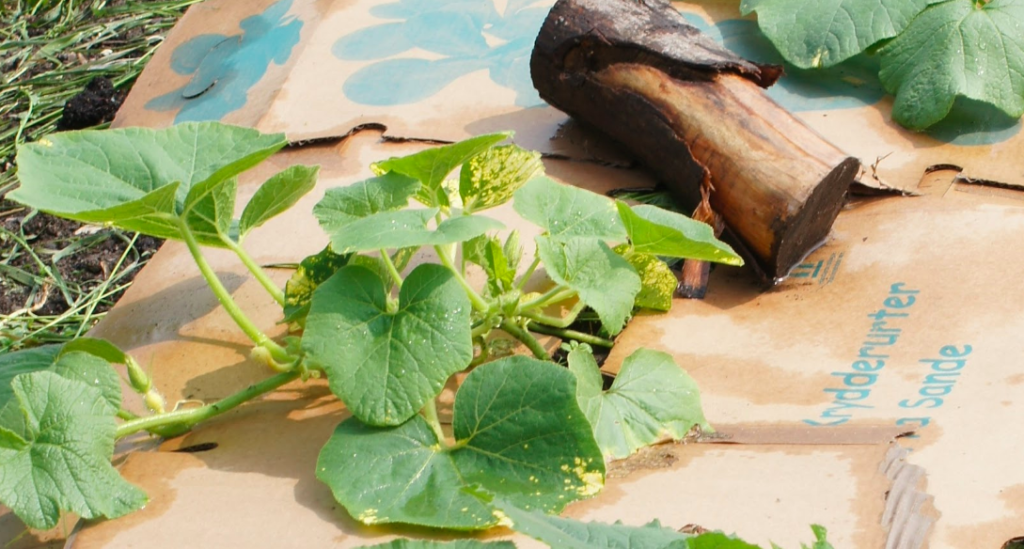
Can we water the garden less if we cover the soil with something? Cover some soil with newspaper, mulch, straw or grass and leave some soil bare. Have students figure out how you can do this as an experiment.
Problem: Can we water the garden less if we cover the soil with something?
You need to formulate some hypotheses. Natural hypotheses would be, for example: we think we can water less when the soil is covered, we think we need to water less on bare soil, we think it doesn't matter if the soil is covered.
You need to make a plan for testing the hypotheses and for how you will document the experiment. Soil moisture can be measured simply by feeling with your hand whether the soil is moist or not, and measuring with a ruler how deep you have to dig to find moist soil. Alternatively, you can (also) measure with a moisture sensor. Feel free to take some pictures during the experiment.
After completing the experiment, you can write a report, where you set up the problem, hypothesis, how you investigated the problem and what you came up with.
Useful background information and links
- 1 mm of precipitation = 1 liter of water on 1 m 2
- 30 mm of rainfall over a couple of days = a real root soak. That is, enough water to penetrate all the way down to the roots.
- Ground cover: When growing, you can either have bare soil around your plants or cover the soil with something. Common ways to cover the soil are: cardboard, newspapers, grass clippings, straw and ground cloth. Ground cover ensures that the soil dries more slowly, microorganisms thrive better and there are fewer weeds. If you have a lot of problems with snails, ground cover can become a bigger problem.
Facts
Estimates of how much water the food we eat uses . 200 g of beef uses approx. 3000 liters of water. The figure includes the production of animal feed.
Estimates for how much water consumption, CO 2 , and area different foods take up. 1 kg of carrots uses an average of about 195 liters of water. A carrot weighs about 75 g. This means that a carrot has been watered with about. 15 liters of water.