Join us under the sea – and into the working process of artist and landscape architect Elin T. Sørensen , where the marine world is our teacher and source of knowledge and inspiration. The exhibition is a sensory experience suitable for people of all ages – with a separate research station for the little ones.
Norwegian BioArt Arena (NOBA) is the Science Park's new initiative on art and artists who work with partly living materials in an encounter with the world and toolbox of science. NOBA is unique in the Norwegian context and the first physical arena for bio-related art in Norway.
BioArt is interdisciplinary in nature, employing scientific processes, methods, approaches and tools, often in close collaboration with partners from other fields and other species and organisms. Through these processes and connections, the ecological, geographical, political, biological and cultural are discussed.
NOBA's very first exhibition in Vitenparken is an art experience that arises in the encounter with the coastal landscape and the sea, the inhabitants of the sea – the marine plants and animals, those who research the sea – the marine biologists and many more.
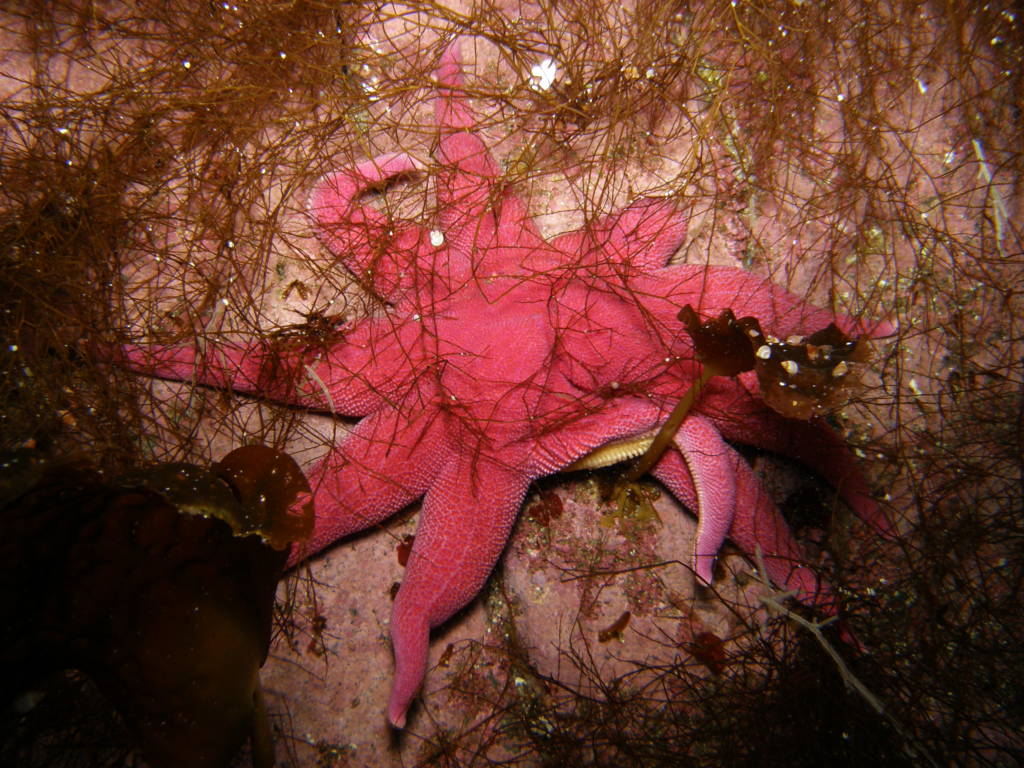
"Solstjerna"
Gul eller glattsolstjerne (Solister endeca) er et rovdyr, som særlig lever av andre sjøstjerner eller pigghuder og bløtdyr.
Solstjerna er gul til fiolett i farge og finnes vanligvis fra 30 meter og dypere.
Utbredt langs kysten av Sør-Norge og Finnmark, også funnet på Svalbard.
Undervannsfoto: Pernilla Carlsson, marinbiolog NIVA
OCEAN
Marine ecosystems are under pressure all over the globe. What is at stake is the diversity of species and their ecosystem functions – which are also vital for us on land. But where cities meet the sea, we humans have distanced ourselves from our connection to the sea. The sea is a bio-ecological zone of great importance to all life on earth. We can also learn this by studying fossil material – because the closer to the shore, the more fossil life there is to be traced. So far, the tendency here in Norway is that urban development is based on human interests. But how can we develop into the sea without destroying life in the water – because then we are also destroying ourselves.
Starfish and pond germs on NTP bricks from experiments at NIVA research station Solbergstrand, October 2019. Photo: Annike Flo.
In order to help create better living conditions in urban sea areas, we must immerse ourselves in the seascape and try to understand life underwater as best we can. Artist and landscape architect Elin T. Sørensen has done this in her doctoral thesis. She literally goes below the surface and discovers a world that is quite different from that on land. A world that houses enormous forces with marine organisms that live from the shoreline down to the greatest depths. To find ways to co-create with care for mussels and other sea creatures, she explores the sea through one-on-one encounters with marine life, inspired by what Rachel Carson calls the ethics of wonder .
Bryozoan colony living on bladderwrack. Electron microscope photo: Lene Cecilie Hermansen, Imaging Centre, NMBU
To get closer to the sea, Sørensen has also connected to the marine field. Together, marine biologist Eli Rinde at the Norwegian Institute for Water Research and Elin have come up with a diversity-promoting marine landscape architecture . The problem when we create our functional and rational fjord-side residential areas is that the natural coast is straightened and flattened. Then the qualities and important ecological functions of the natural shore zone are also erased. In order to physically provide space for life underwater, a 'diversity-promoting marine landscape architecture' helps to bring these qualities back.
HAV shows examples of proposed solutions that have arisen from artistic visions in the face of marine biology, the tidal landscape and, not least, the sea creatures themselves.
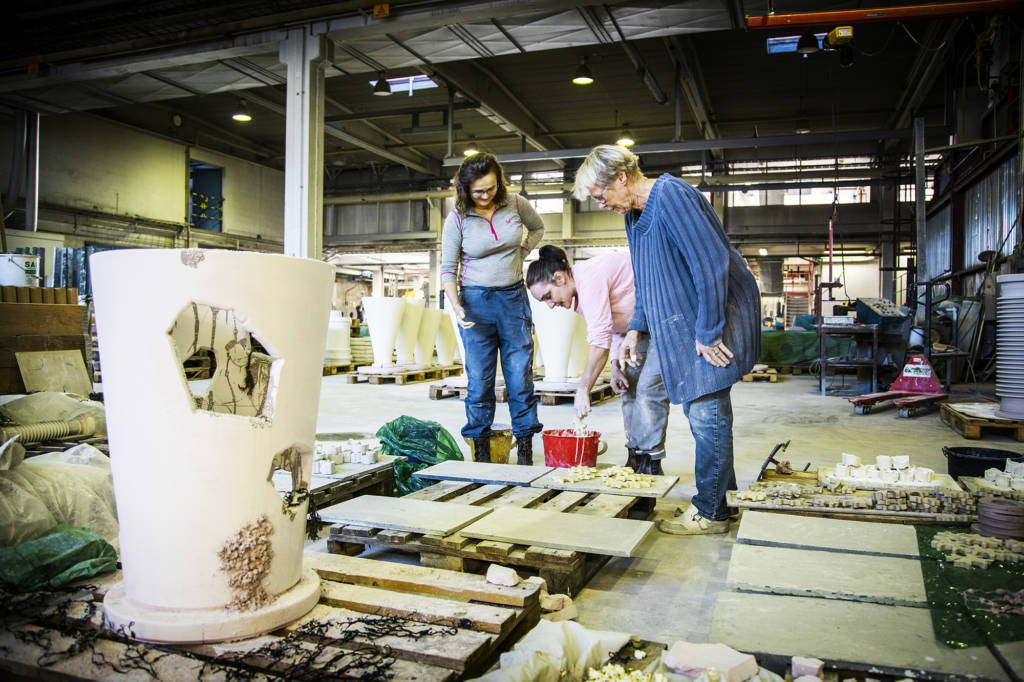
Marine biologist Eli Rinde and landscape architect Elin T. Sørensen receive advice from artist and ceramicist Tulla Elieson. Photo: Karin Beate Nosterud, NTP January 2020.
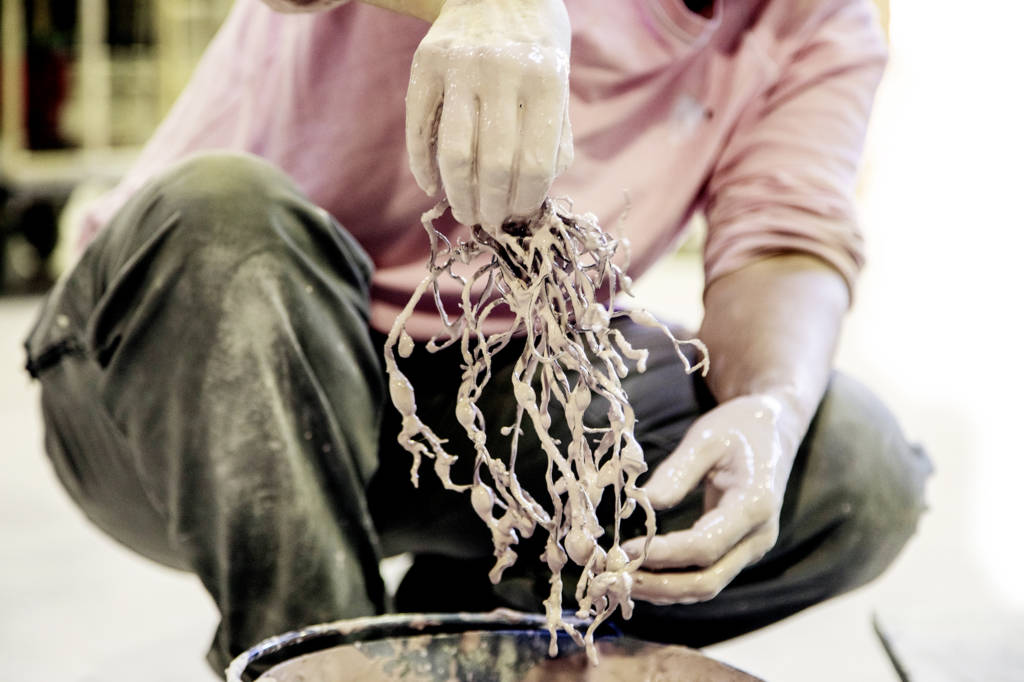
Seaweed being dipped in porcelain paste. Photo: Karin Beate Nosterud, NTP January 2020.
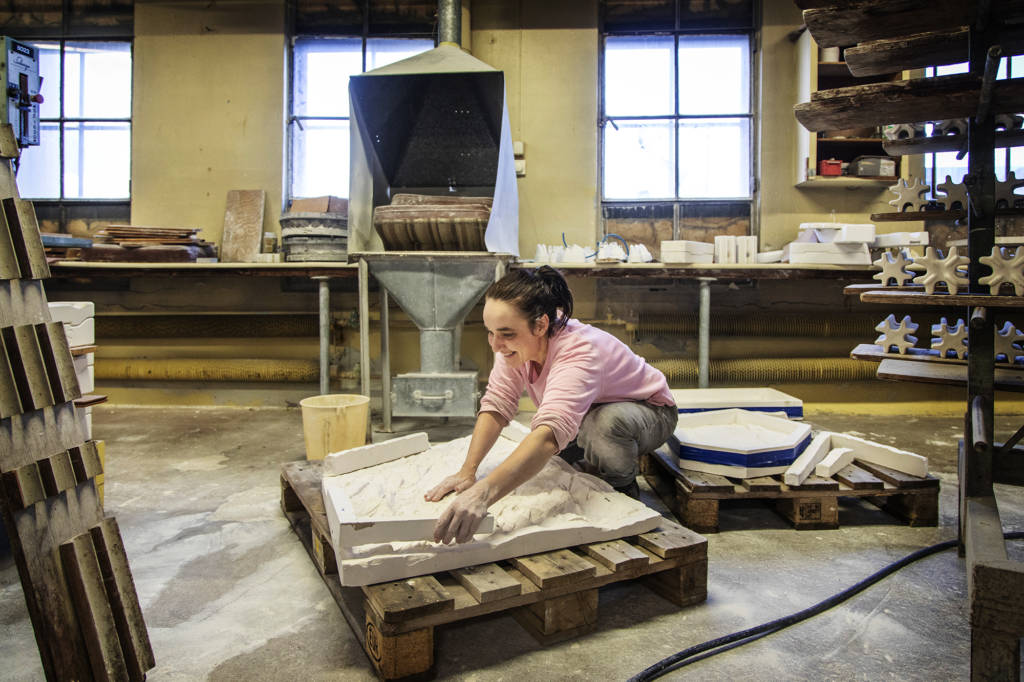
Cambrosil molds in plaster. Photo: Karin Beate Nosterud, NTP January 2020.
Elin T. Sørensen is a visual artist, animator and landscape architect educated in Norway, Finland and Estonia. Her practice is based on a sensitivity to place and a strong fascination with nature and our relationship with the sea.
Environmental issues have characterized Søresnen's work since 2004. She works with open artistic processes that are based on interaction with places, people and other disciplines.
Sørensen is in the final stages of her doctorate with the working title Making Space for the Blue Common . Here she addresses current practices for development in the sea and investigates new solutions for the underwater landscape and the urban shoreline. The case area of the doctorate is Oslo's urban sea area with island landscapes and a tidal zone in the inner harbor basin and the Inner Oslofjord. Here, a more varied tidal landscape is needed, which gives us safe fjord-near urban spaces with good living conditions for life in water and on land.
Elin T. Sørensen wants to get close to life in the sea and get to know all the small life forms that we otherwise overlook; such as wrasse, pond germs, mussels and shore crabs. In her work, she tries to find new ways to play as a team with those we share the world with. Photo: William Olsson-Tanding 2019
HAV is curated by Annike Flo, project coordinator NOBA.
The exhibition's geo-poetry is created by Johan Petter Nystuen, professor emeritus, Department of Geosciences, University of Oslo.
HAV supporters
Norwegian Institute for Water Research (NIVA) and NIVA research station Solbergstrand, Drøbak aquarium, Norwegian Technical Porcelain, plasterer Jean Waldemar Hoff, NMBU Realtek pilot workshop.
HAV is being developed with financial support from
NMBU Seed materials for “Marine plants and coastal landscapes”, a collaboration between BIOVIT and LANDSAM.
NMBU's Idea Development Fund in collaboration with ARD Innovation.
KORO Local Community Scheme and Sparebankstiftelsen DNB for the art project “Under/sea”, a collaboration with Fjordtunet, Anne Beate Hovind and Spearos Oslofjord club for freediving, snorkeling and underwater hunting in the Oslofjord.
Program for artistic development work. DIKU (PKU), Art Music Design, University of Bergen (UiB), Global Social Challenges UiB for the art project “Matter, Gesture and Soul”, a collaboration with Geir Harald Samuelsen.
PhD position 2016-2020 at the Department of Landscape and Society (LANDSAM) NMBU, with main supervisor landscape architecture professor Anne Katrine Geelmuyden and co-supervisor composer Christian Blom.
Ås municipality, grants for cultural events.
Big thanks to:
William Olsson-Tanding; Eli Rinde (NIVA), as the doctoral marine mentor; Johan Petter Nystuen (UiO) as geology mentor; underwater advice and photos from Hartvig Christie and Pernilla Carlsson (NIVA); 3D visualization and digital fabrication by artist Ivar Kjellmo; 3D printing by artist and creative technologist Boris Kourtoukov; Klaus Bareksten and Drøbak Aquarium for loan of aquarium and sea animals from Indre Oslofjord; Michael Sagen and NMBU Realtek pilot workshop for design of system for Seabed/shelf; Noshin Naseri-Lordejani and Jean Waldemar Hoff for design of Bladder Tongue/signal buoy. Ceramists Tulla Elieson, Eirik Gjedrem and Ann Beate Tempehlaug for guidance on clay and ceramic production; Kaia Kjølbo Rød and Jorun Pedersen ARD Innovation; Hilde-Gunn Opsahl Sorteberg BIOVIT and Ioaioannis Theodorou Sorbonne/ Station biologique de Roscoff; landscape architecture student Runa Tunheim; Anne Beate Hovind, Tillik Margrete Motzfeldt Haustveit, Karin Beate Nosterud; Spearos Oslofjord and Sergey Gilmiyarov for harvesting sugar kelp; video editing by Ivar Kjellmo and Jon Gorospe; the exhibition's sound & sound design by Film IT; risography printing by Camilla Skibrek.
See photos from the opening and read more about the exhibition here .