It smells like money! You can say that when you drive past a field where manure has just been spread, but why do you say that? In this program, students test out different fertilizers in the school garden.
Description of the activity
Introduce the topic of fertilizer to the students. We say it smells like money or call it farmer's gold. So we are talking about poop, or rather livestock manure. How can smelly poop be a resource? In everything organic there are nutrients that are part of a cycle. The substances change form, but do not disappear. Fertilizing with organic fertilizer is a practical example of just this.
Here, the students will collaborate to develop a fertilizer experiment with a problem, hypotheses, plan for the work and a report at the end. The students grow two crops that are nutrient-demanding and one crop with a moderate need for fertilizer. We suggest kale, lettuce and cauliflower. Kale grows best with a good supply of nutrients, cauliflower likes lots of fertilizer, while lettuce grows quickly and does not have time to use up that much nutrition before you harvest it. Divide the growing area into at least three plots of 1 m2 each . Make sure to have some distance between the squares, 40 - 50 cm. is fine. You can also grow in pallet frames . A pallet frame is at least 1 m2. Give the three plots of soil different treatments. One plot remains unfertilized. This is the control plot. The other plots of soil are either fertilized with fertilizer type no. 1 or fertilizer type no. 2.
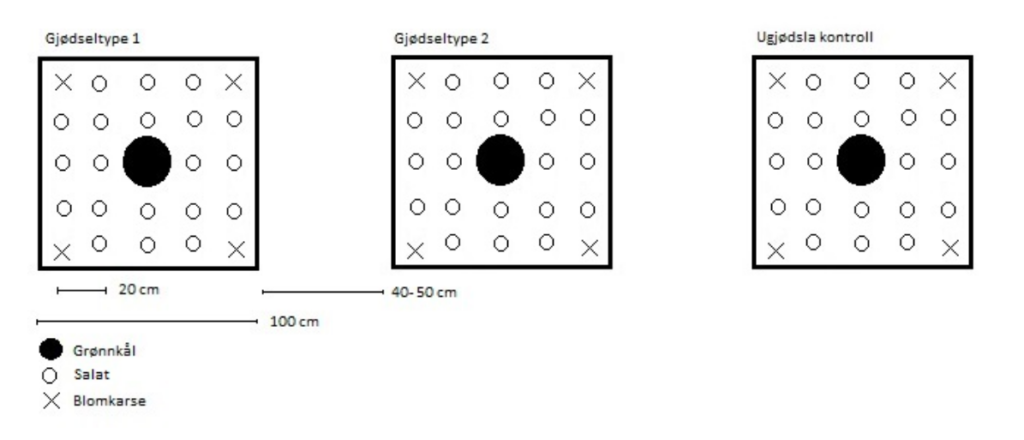
Feel free to expand the experiment to more square meters and types of fertilizer. Or make the experiment more scientific by having multiple repetitions of the types of fertilizer you are testing.
Go through together how it is a good idea to set up an experiment. Here, following the model from the curious person method :
- Problem statement. E.g.: What is good to fertilize with? This problem needs to be narrowed down to what we mean by good? The problem statement should be specific. E.g.: What is good to fertilize with to make vegetable plants grow a lot and look healthy. A healthy plant is green and not limp.
- Formulate hypotheses that answer the problem. Let the students brainstorm what they can fertilize in groups and formulate hypotheses. Which hypotheses can be tested?
- Create a plan to test the hypotheses and to collect data. How will we measure the results? For example, it could be: number of cm. of growth, color differences, taste differences and weight. Implement the plan and document the collection of data.
- Analyze what you have found out. Does it answer the question?
- The findings are compiled in a report.
Fertilize the soil and plant kale, lettuce and then flower cress when the danger of night frost is over. For a more detailed cultivation description, see below. When the summer holidays are approaching, you will harvest the lettuce. Make observations first. What is the leaf color of lettuce, kale and flower cress? Are there any differences? What does the size of the leaves look like at first glance? Harvest the lettuce. Keep the lettuces from the different plots separate. There are several options for data collection here, but the most natural is perhaps to weigh the lettuces. Do a taste test as well. Sort and summarize the findings. What are we researching? Does the data give any indication of whether any of the hypotheses are correct? Is there any significant difference in the lettuce yields between the different plots? What are possible sources of error?
Once the lettuce is harvested, you can give the kale and flower cress a second round of fertilizer.
Salad mat
- Did the patches of land produce the same number of grams of lettuce? Make a bar graph.
- Is it most appropriate to talk about grams, hecto or kg of lettuce?
- If you were to divide the salad between you, how much would each person get?
After the summer holidays
When you are back from your summer vacation, it is time to compare the kale and the cauliflower. What can you observe? Are there any striking differences? How tall is the kale in the different fields? What is the color of the cauliflower and kale leaves? Harvest the kale leaves in the different fields and weigh them. If you leave the stem and leaves at the top of the kale, the kale will continue to produce leaves throughout the fall.
Kale mat
- Make a bar graph for height and weight. Do the patches of soil produce the same number of grams and cm of kale? Make a bar graph.
- Is it most appropriate to talk about grams, hecto or kg of kale?
- If you were to divide the kale between you, how much would each person get?
Let the students work with the data they have collected in groups. They should find arguments for the effect that the different types of fertilizer have had and create a report with a conclusion.
Bonus task
Make different fermented kale chips. Is it possible to taste the difference? https://www.matprat.no/oppskrifter/kos/gronnkalchips/
Suggestions for different types of fertilizer
- Garden fertilizer/complete fertilizer/artificial fertilizer/garden fertilizer (NKP) (dear child has many names)
- Compost from food waste or garden waste
- Livestock manure: horse, cow, goat, sheep, chicken or rabbit
- Grass cutting
- Seaweed (rinse it to remove salt residue or leave it in the rain before using)
- Bone meal or blood meal (can be purchased at garden centers)
Cultivation description
Mix different types of fertilizer into the soil on the different patches of soil.
Sow lettuce and kale plants indoors at the end of April or the first week of May to have time to harvest small heads of lettuce before the school holidays. Sow the lettuce seeds about 0.5 cm deep. If you use old grape boxes, you can sow in four boxes with about 20 seeds in each box. Then you have some extra plants. Sow the kale seeds one by one in each pot. They must be kept in the light and it is a good idea to pull plastic wrap over the pots until the seeds have germinated.
After three to four weeks they are ready for planting. They should be left for a maximum of five weeks.
Plant two kale plants in each patch of soil to be on the safe side. One must be removed after two to three weeks, otherwise they will inhibit each other's growth. At the same time as you plant lettuce and kale, sow flower cress. Sow three seeds in each corner of the patch of soil. Be careful with watering in the first few weeks after planting. Read more about pre-cultivation and watering here.
Background information, funfacts and links
Pointer to what are reasonable amounts of fertilizer:
In the experiment you create, you can of course create a variant where you test what happens if you fertilize more or less than reasonable amounts.
- Garden fertilizer/artificial fertilizer. Fertilize with the amount stated on the bag.
- Compost has no maximum limit and can be used at any time of the season.
- Manure (except chicken manure) Max 3 kg per square meter. Fresh manure should not come into contact with food so the fresh manure should be used long before you harvest. For example, the manure can be divided so that 1.5 kg is given in the spring and 1.5 kg is given when the radishes are harvested. If the manure has been composted, you don't need to think about this. Ps. Cow compost bought in bags is composted and contains a lot of peat so here you can use much more than 3 kg. You don't need to be afraid of using too much.
- Chicken manure. Use a maximum of 2 dl per square meter. Chicken manure from garden centers is heat-treated and does not contain animal contamination, but it is strong and should not come into direct contact with plant parts.
- Grass cuttings. Lay 5-10 cm at a time from spring. Lay a new layer when the previous one has broken down. After the end of July, there is not much point in adding more.
- Pliers
- Bone and blood meal. Use the amount recommended on the package.
Nitrogen
Nitrogen is the most important nutrient for promoting plant growth. A lot of nitrogen makes plants dark green, a little makes them light green. A lot of nitrogen gives a lot of leaves and few flowers, a little nitrogen works the other way around. A lot of nitrogen makes the cell walls in the plant thin and more vulnerable to attack by fungi and pests. Some planets want a lot, others little nitrogen and the optimal amount gives healthy plants with good growth. The air around us consists of about 78% nitrogen. We breathe in and out fertilizer! The nitrogen in artificial fertilizers comes directly from the air. The nitrogen in organic fertilizers is part of the nitrogen cycle. Bacteria obtain nitrogen from the air and make it available to plants, plants take up nitrogen, animals eat plants, the animals die or poop, the animals and their manure decompose and the nitrogen becomes available again for plants.
Too much fertilization is an environmental problem. When it rains, nitrogen is washed out into streams and rivers, and if there is too much, you can see a lot of algae, cloudy water and the stream regrowing. Nitrogen can also form a compound that becomes nitrous oxide. It is a very strong greenhouse gas and one of the reasons why agriculture contributes to climate change.
Another variation of fertilizer experiment
https://www.agropub.no/fagartikler/mokkaprosjektet-et-tverrfaglig-forskerspireprosjekt
Benefits of using organic fertilizer:
You get rid of a waste problem while recycling organic matter and nutrients, and the topsoil you grow in stays healthy.