In this project, we will create small classroom composts with earthworms on display. They do not smell bad and inspire an exploratory approach to decomposition.
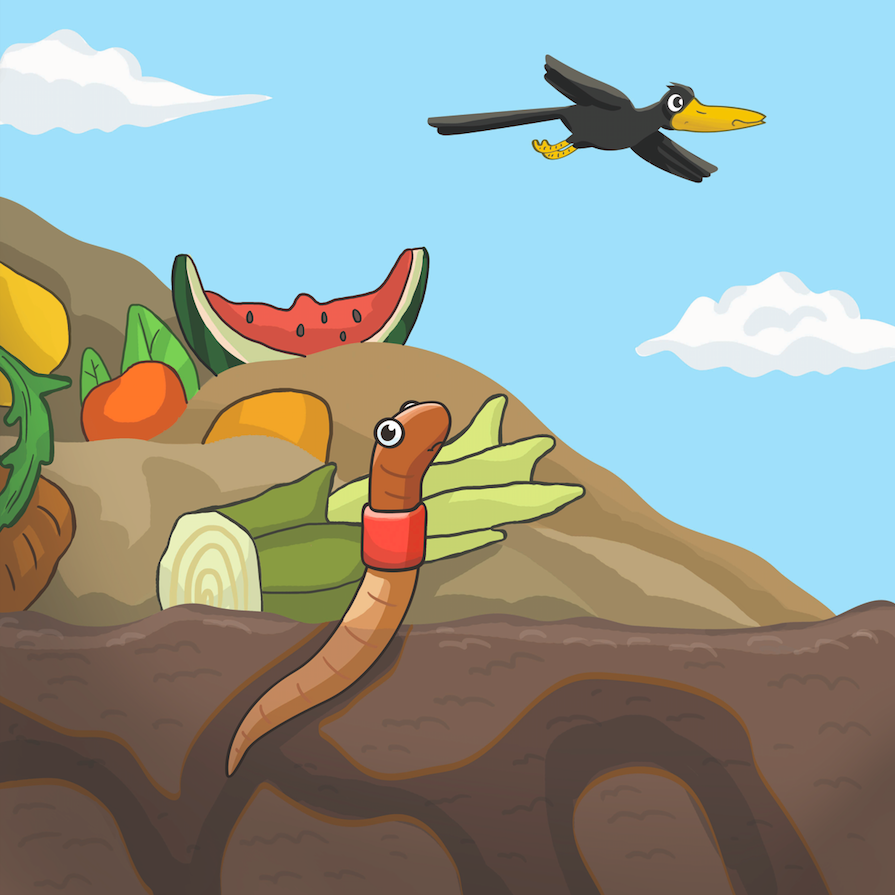
The food we eat is under attack from natural forces in our environment. We are also under attack, everything living and everything that has been alive is home to millions of small and slightly larger organisms that both protect us and can be harmful. When life ends, nature takes over and creates compost. But compost is also the beginning of life and almost all the food we eat was once compost. The earthworm is a compost worker who works tirelessly for free to recycle nutrients. Get to know someone who loves compost!
Write a breakdown poem
Most people have had an old lunchbox. Can anyone tell horror stories from the fridge, a forgotten lunchbox, or maybe the food waste bin? Everyone writes down five words that describe the smell, the sight, what it felt like to touch if you touched it or maybe it even had a sound? So we are looking for descriptive words for something disgusting that was breaking down. Collect the words on a board. Use the collection of words as inspiration and write a poem about old food.
Make an earthworm terrarium
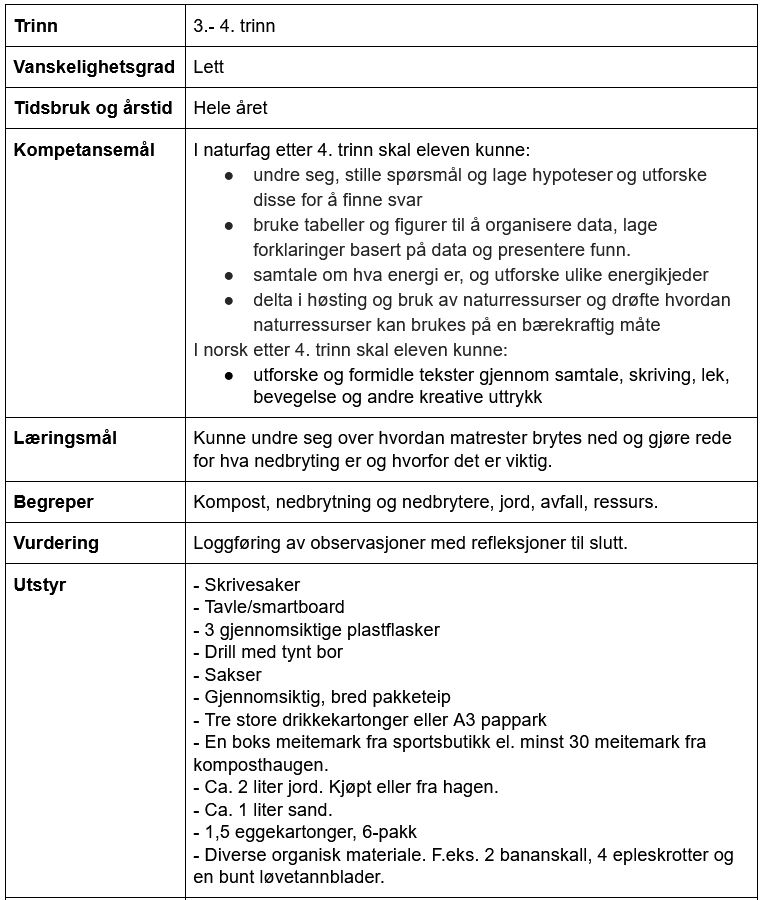
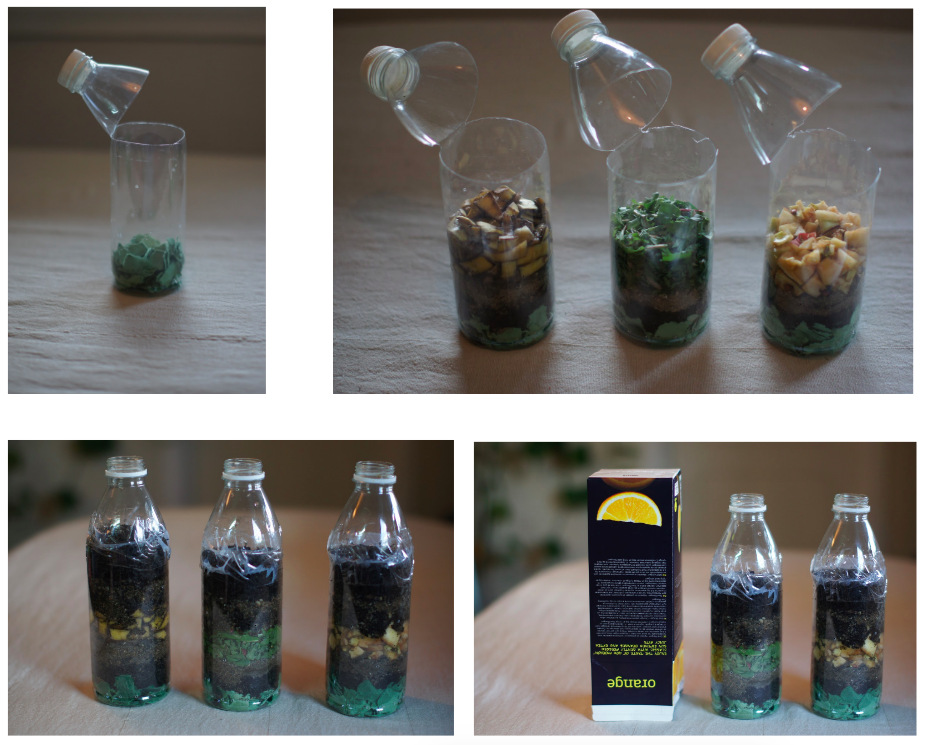
Earthworms are decomposers. Study how earthworms work to compost food scraps and other organic matter. Drill small holes in three clear plastic bottles and cut them in half.
Procedure
- Place pieces of egg carton in the bottom. Students can tear the egg carton into pieces and cut up organic material.
- Layer soil, sand and organic material in the bottles. One layer of organic material is enough, but several layers of soil and sand are good. Then you can see how the earthworms mix the layers over time.
- Make at least three different compost bottles that you can compare. For example: banana peel compost, apple core compost and leaf compost. Or maybe you want to have plastic in one bottle? If you want to have a scientific approach to the decomposition study, it is good to weigh the organic material so that each compost gets the same amount.
- Distribute the earthworms into the three bottles.
- Make a cardboard cylinder out of dark cardboard, or use a large beverage carton that you place over the terrarium so the earthworms can work in the dark when you are not looking at them.
Observation and logging
Observe changes over time. Keep a log of how the organic waste changes color and texture and how the earthworms move the contents of the terrarium.
Log the number of earthworms and the contents of the bottles at start-up. It is also advisable to describe the smell.
- Observations day 1:
- Observations day 7:
- Observation day 14:
- Observation day 21:
- Reflections: What happened?
If it looks like the bottles are getting dry, you can gently moisten the contents. Don't use too much water, as this will reduce the oxygen level. When the contents of the bottles look completely decomposed, or when you feel you've finished the project, you can open the bottles and take a closer look at the contents. How does the soil feel and smell? Are there any traces of the original source? Are there as many earthworms? Do you find small, oblong, yellow balls in the soil? If so, these are earthworm cocoons and the next generation of worms. You can release the earthworms into a compost pile, give them to someone who wants to fish or have earthworm compost, or maybe you know someone with chickens or ducks. The soil is great for growing something in, and if you grow something edible, the circle is closed and the cycle is a circle. Food waste becomes new food.
Background knowledge, funfacts and links
A compost poem by Jacques Prévert
BREAKFAST IN THE GREEN
Eat on the grass
Hurry up!
A beautiful day
Will the grass eat you?
Did you know that
- Fly larvae, which are decomposers, breathe through their rumps so they can dive their entire heads into what they eat?
- There are more living beings in a handful of compost than there are people on the entire planet? Luckily they are so small, otherwise it would be cramped.
- skrukketroll is another decomposer suitable for indoor terrariums. https://www.naturfag.no/forsok/vis.html?tid=1891894
- Composting is at least 12,000 years old. Archaeologists have found remains of Stone Age compost in the British Isles. There, they grew their food right in the compost.
- Native Americans sometimes wrapped the seeds they were going to grow in pieces of fish to fertilize the plant.
- Most snails only eat dead plants and are therefore decomposers and scavengers. But the boa constrictor eats other snails (its diet is about 70% meat) and can help keep the number of harmful snails, such as the brown slug, down in the garden. The boa constrictor, leopard snail or tiger snail as it is also called, is territorial and can divide rival snails with one of its fangs. It breathes through a hole on the side of its “neck” and lays eggs through another hole on the “neck”. It has eyes on stalks like all snails and glides through its life on a self-produced mucus.
Earthworm biology
An earthworm does not have eyes, but can sense light with its entire skin, it is both male and female, or hermaphrodite as it is actually called. Earthworms that have something that looks like a belt around their stomach are sexually mature and can make small yellow cocoons with the next generation of earthworms in them. When there are many earthworms on the move in the rainy season, it is often to find new places to live. Then they can rarely climb up trees, on house walls and on cars. They have to move when it rains or they will dry out.
https://www.ba.no/nyheter/forskning/natur-og-miljo/nei-det-regnet-ikke-mark-de-er-bare-pa-vandring/s/5-8-107957 And those who grow food should be happy with earthworms. The earthworms work for free to make the soil airy and nutritious.
More in-depth information about earthworm biology can be found here .
How to make a slightly larger worm compost for soil production and food waste management can be seen here .
A teaching program with earthworms as a theme can be found here .