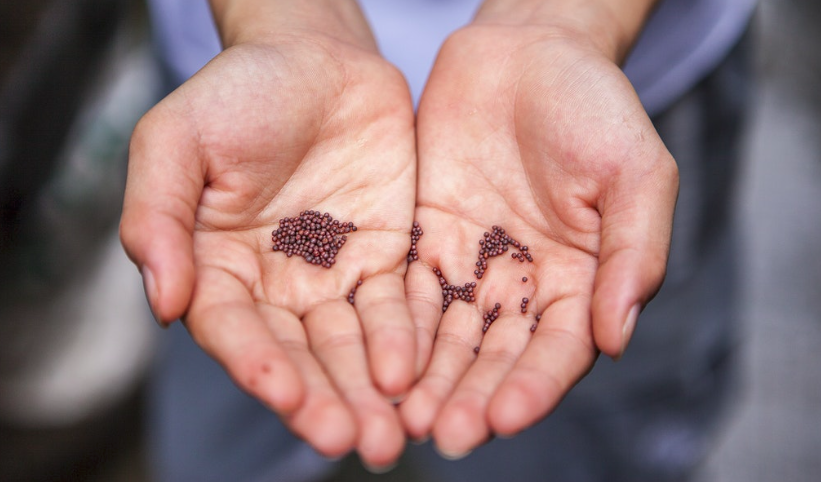
There are many things around us that we don't think of as containing water. Here we cut out an apple face and observe what happens when the water evaporates from the apple. We also do some simple experiments with evaporation and draw the water cycle with our own twist.
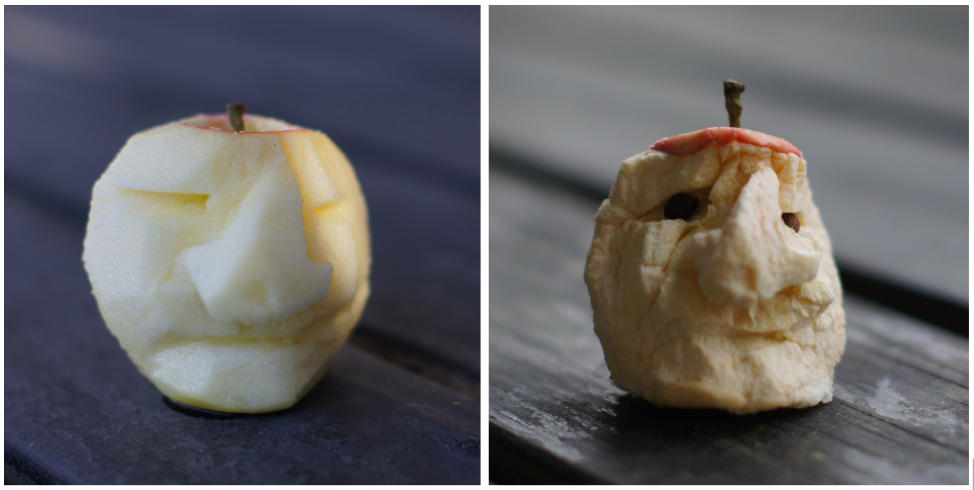
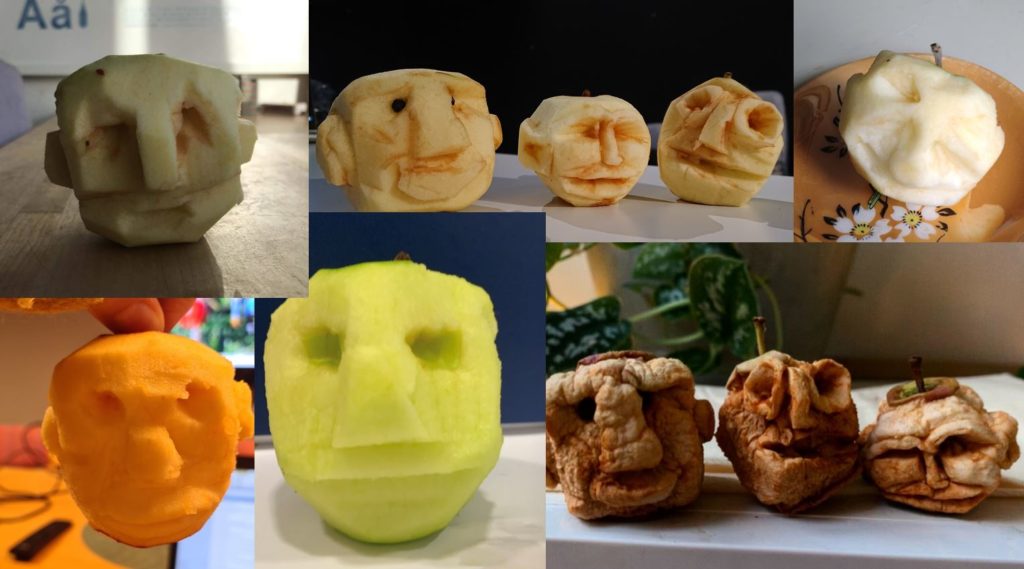
Examples of freshly cut and dried apple wrinkled noses, from the School Gardening Seminar 2020.
Part 1: A clove experiment, evaporation from us, a tree and an apple
Evaporation from a tree
Put a bag around some leaves on a tree outside. What happens? The tree sucks up water from the soil. The water evaporates through openings in the leaves that are so small that we can't see them. When you put a bag around the leaves, you can see that the inside of the bag becomes wet after a few hours. Choose birch.
Evaporation in a glass
We put two jars with a little water next to each other. One with a lid and one without a lid. What do you think will happen to the two jars with water? The water in the jar without a lid evaporates. In the jar with a lid, the water also evaporates, but it hits the lid and the walls of the jar, condenses and runs down the sides of the jar again. Depending on how much water you have in the jars, it will take a day or two before all the water in one jar is gone.
Carnation experiment
The flower experiment is a bit difficult for students to do, so it works best if the teacher does it as a demonstration. It will take a few days before you see the result. Cut the stem of the carnation or rose in half lengthwise so that it has a split stem. Put the stem parts in separate glasses. Put food coloring in one glass or a different color in the two glasses. What do the students think will happen? And when you have observed the changes, what do you think has happened? The flower is constantly sucking up some water with color. The water evaporates while the color remains in the flower. When the stem of the flower is split, you can see that one half supplies one half of the carnation with water while the other supplies the other. Roses distribute the water differently.
Evaporation from us
The students each get a bag. They are told to breathe OUT into a bag several times. They have to squeeze the air out between each time. What happens? Hold on until it gets wet inside the bag. It takes about 20 big breaths. Did you spit in it? Reflect a little in plenary about where the water comes from. We actually lose a lot of fluid when we breathe. It is wet in the mouth and our lungs are also moist. The water in the body fluids evaporates when we breathe. When it is cold you can see the water as frost smoke.
Evaporation from an apple
Then the students each get an apple. They peel it and cut faces out of the apples. Drizzle lemon juice on the apples. (The lemon can be omitted, then the apples will turn dark brown). Sprinkle some salt on the baking paper. Place the apples on the salt and sprinkle some salt on the apples as well. Make sure the apples are somewhere you can keep an eye on them. It takes about two weeks for them to completely shrivel up. Two peppercorns or cloves make nice eyes if you want to make the face extra lifelike.
Part 2: Summary and drawing of the water cycle
After a couple of days, you talk about what happened to the carnation. After two weeks, it's time to look at the apple experiment as well. What happened to the glasses of water and the apples? Show a classic diagram of the water cycle with the sun, ocean and vegetation. What do the students see? Try to get the students to explain the diagram in plenary. Summarize the experiments you have done. Then the students draw their own versions of the water cycle. How about drawing the water cycle through an apple tree, into an apple and out of an apple head? Or what happens to the cycle if you eat the apple?
Carnation experiment
All plants that have vascular tissue transport water from the root, upwards and outwards in the plant. Then the water evaporates from the surface of the plant. This is called transpiration. You can think of the water as the plant's blood, because it carries nutrients with it. Approximately 98% of the water the plant absorbs evaporates. The rest is used for photosynthesis. A medium-sized birch can transpirate well over 100 litres a day, which turns into humidity and clouds.
Breathe in the bag
We are about 60% water, and every day we exhale about 3-4 dl of water. Water also disappears with feces (0.5-1 dl), urine (9-15 dl) and through the skin as sweat and evaporation (5 dl).
Frost smoke
Inside the lungs and mouth it is humid and our breath also becomes humid in the form of water vapor. Inside the body it is hot. When the warm breath hits the cold air outside the body the water condenses and collects in larger droplets that we can see. Fog is also larger droplets of water that we can see. If the droplets had been even larger they would have fallen out of the air as rain.
Experiment
C rea k a cloud in a bottle , by the Norwegian Science Center. Water stays in the atmosphere for an average of about 10 days before it rains or snows again, while water in glaciers and groundwater can stay in the same place for several thousand years.
Some say that the water molecules you drink were once drunk and peed out by a dinosaur, but the hydrogen and oxygen break down and find each other again over time, so it's more accurate to say that you might be drinking water molecules that a cow, mouse, or blue whale peed out. And when you exhale, sweat, and pee water, that water can turn into clouds.
Background knowledge, funfacts and links
Diagrams of the water cycle: